Using light to cool sound
Laser light has been used to cool atoms down to near absolute zero. The technique is simple, if versatile. (And includes some history involving a little-known Indian physicist.)
Laser light is shined on an atom that's made to move towards the source of light. When the atom absorbs a photon, it slows down because of the law of conservation of momentum. The atom then emits the photon from a different direction.
By Newton's third law, it should then receive a 'kick' in the direction opposite to this emission. But because the photons will be emitted in various random directions, their total 'kick' will be far smaller than the brakes applied by swallowing photons from just one direction.
By carefully tuning the laser's frequency and intensity, scientists can ensure that the atom absorbs and emits enough photons to slow down. And when an atom slows down, it simply means – in the language of thermodynamics – that it has cooled down.
This entire process involves a coupling between light and matter, nothing else. The atom absorbs the photons and then spits them out – i.e. the atom interacts with electromagnetic radiation. The resulting drop in temperature is simply the result of the atom losing its kinetic energy. There are no other forms of energy involved.
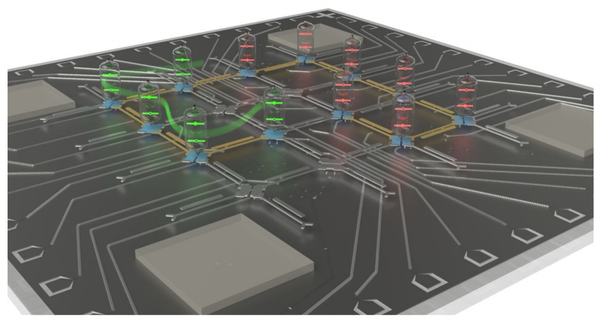
However, because laser-cooling is such a cool technique, scientists have been curious about whether it could be used to slam the brakes on the kinetic energy of objects other than atoms. In a new study, published November 27, that's what scientists say they have done (preprint here).
And this time, what they have done might just be cooler: they have used laser to slow down sound waves.
The technique is the same – and equally simple – except for one small change. In the case of atoms, photons mediated the interaction between the laser light and the atom. In the case of sound waves, there is a second mediator: Brillouin scattering.

We know sound in the air is simply a series of blocks of compressed and rarefied air. Another way to describe this is as a wave. The air is less dense in the rarefied parts and more dense in the compressed parts, so the sound is effectively a density wave. When sound passes through a solid, it does so through a similar density wave.
All waves carry some energy (according to the Planck-Einstein relation: E = hv, where h is Planck's constant and v is the wave's frequency). For example, the electromagnetic wave carries energy that, at certain frequencies, we call light or heat. The energy carried by a density wave moving through a solid is, at some frequencies, perceived by the human ear as sound.
So when photons from a laser can be used to remove energy from the density wave, it will effectively reduce the energy of the sound waves. We just need to figure out how to create a coupling between the laser photons and the density waves. This isn't hard because part of the answer is in the language itself.
How do you couple a particle to a wave? You can't – unless you can describe both of them as waves or both of them as particles. This is possible in physics through the wave-particle duality. You'll remember from high school that light is both waves and particles. It's just two different ways to describe the transport of electromagnetic energy.
You can do this with sound as well. It can be described as a density wave or a particle moving through a medium – two ways to describe the transport of acoustic energy. These 'sound particles' are called phonons (cf. quasiparticles).