To be Indian is to set records
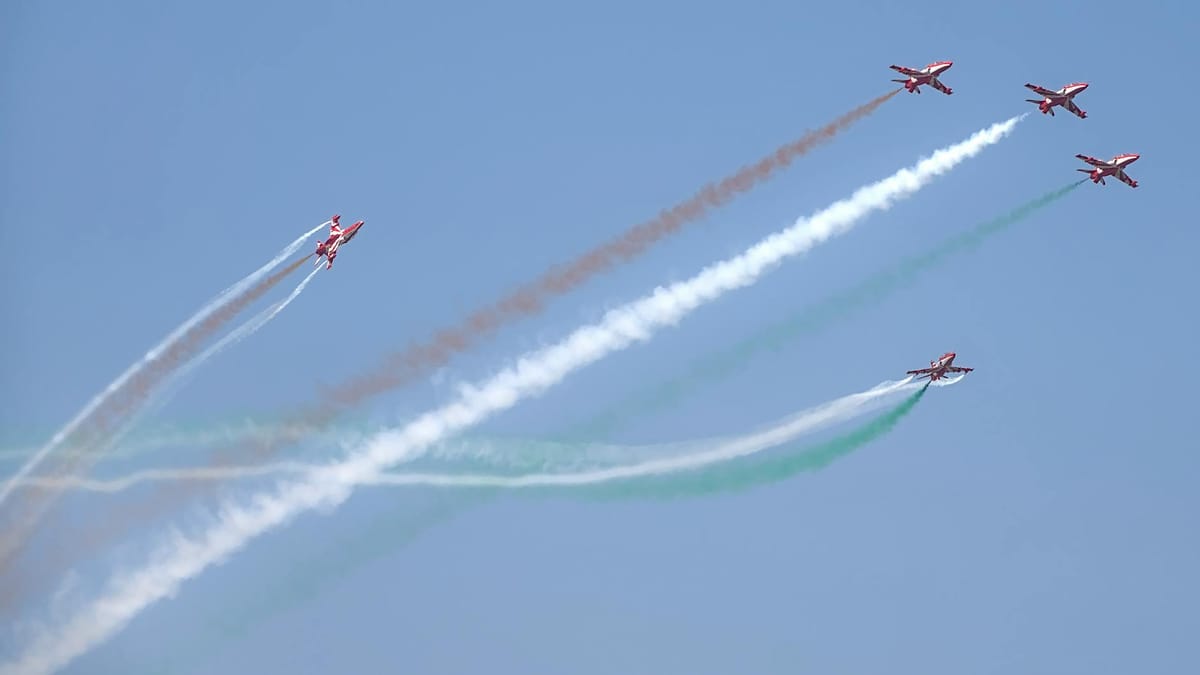
For all the ways in which the Indian people are divided these days, they're seemingly united in their desire to set records. On January 22, a tinkerer named Sohan Rai, a.k.a. “Zikiguy”, said on Instagram that he and his team “are planning to do India’s highest ever flag hoist in near space for this Republic Day”.
What is it about setting records? The national BJP government itself, which -- from the day Prime Minister Narendra Modi was first elected -- has tried repeatedly to extend the record books backwards into mythology, asserting ancient Indians piloted interplanetary aircraft and performed plastic surgery millennia before the advent of modern science. But recasting religious metaphors like the elephant-headed god Ganesha as literal medical feats only reveals the ideology's own neurosis to validate Indian heritage using the yardstick of modern Western empiricism. It's practically a retroactive attempt at record-setting where the leadership, admitting it can't dominate the prevailing global hierarchy, simply imagines India to have been the original superpower.
The 2016 Tamil film Joker brought the same pathos to clearer light through its protagonist, Mannar Mannan (Tamil for "king of kings"), who abandons democratic petitioning and other mechanisms in favour of performing absurdity — much as farmers from Tamil Nadu did when they protested in Delhi in 2017 by holding dead rats and snakes in their mouths — to draw the state’s attention. The state, the thinking seems to be, has become inured to 'normal' poverty and will only react to spectacular embarrassment.
The Limca Book of Records is a symbol of this syndrome. The then Parle-Bisleri chairman Ramesh Chauhan conceived of the book in 1986 and first published it in 1990 as an extension of the 'Limca' brand, as a tool of "soft" marketing. That it exists at all is because Indians alone are setting so many records, even those bordering on the facile. Today the Limca Book is the second-oldest of its kind in the world, after the Guinness Book, and accepts applications from Indians worldwide provided they hold an Indian passport — a requirement that reveals how both citizenship and record-setting are equally emblematic of being Indian.
A 'record' is an event that documents primacy through some extreme act, and the extremum can take different forms depending on what sort of primacy one wishes to establish. Prime Minister Narendra Modi built the world's tallest statue in Gujarat and Maharashtra responded by promising a taller one because the BJP was engaging in a pissing contest and the other was furthering the same stunted logic by contending that one didn't have to be a nationalist to piss higher, for instance.
More recently, when astronaut Shubhanshu Shukla first went to space onboard the Axiom-4 mission, various media outlets reported that he'd set a record by becoming the first Indian to conduct an experiment in space. By that measure, Indians have scores of records left to set, including becoming the first Indian to cough in space, the first Indian to get out of the right side of bed in space, and the first Indian in space whose name starts with ‘M’. But hey, it's technically a record, and it's printed, and if it's printed it must be true.
In his work, the historian Vinay Lal has argued that the Indian obsession with the Guinness Book is rooted in a deep-seated postcolonial disquiet. He's posited that the colonial experience left India with a sense of "historical incompleteness" because the West had come to be seen as the world's standard-bearer of modernity and 'hard facts'. In his telling, Indians also have a "fetish for numbers" because in a chaotic and often unmanageable democracy, precise numbers — e.g. "typing 103 characters in 47 seconds with a nose" — offer the comfort of certainty and empirical truths, and which also feel scientific.
Records also allow these ordinary persons to be heroes. While achievements like Olympic gold medals and Nobel Prizes require state funding, favourable (and arguably arbitrary) social conditions, political stability, and training/research hardware, the Guinness and Limca records often demand only time and a high tolerance for discomfort. This is why many Indian records are feats of endurance or body modification, such as “longest fingernails” or “most time spent standing on one leg”, rather than exercises of athleticism or brilliance.
The Indian state itself isn’t immune to the same tendencies. For example, the sociologist Shiv Visvanathan has written that the state uses such records to replace complex historical narratives with crude statistics. Thus we have a prime minister focusing on the number of people simultaneously doing yoga rather than engaging with its philosophy in any meaningful sense. The Union health ministry advanced a similarly pathetic claim during the COVID-19 pandemic when it said it was conducting the “world's largest vaccination drive”, betraying its real design: to create a spectacle to unify the mob and to project an image of power and efficiency to mask infrastructural and social weaknesses.
Of course when the people themselves take advantage of their numbers to set records, it’s just quaintly saddening. As Samanth Subramanian reported for The New York Times in 2015:
The first time Nikhil Shukla adjudicated a Guinness world record, two million people turned up. Standing on a makeshift dais just before dawn in January 2012, Shukla gazed with bleary, incredulous eyes; he was 28, and he had never seen such a mammoth crowd in his life. Tolls on the national highway from the nearest city, Rajkot, had been suspended to accommodate the traffic, and Shukla had to trudge 20 minutes from his V.I.P. parking spot, squeezing through dense thickets of bodies, to approach the stage. The throng that gathered in this patch of dusty farmland in western India to watch the event came from villages and towns across the district. They had responded to a call from a Gujarati community organization that, with a vague aim of promoting public harmony, wanted people to pair off and shake hands with one another, setting a world record for the most simultaneous handshakes.
All this is to say that the Indian affinity for records isn’t benign or innocent but is nurtured by an unresolved postcolonial identity that still looks to the West, or Western ideals, to certify its own reality. In this universe the Indian citizen resorts to obscure feats of endurance as a desperate attempt to become visible even as an increasingly authoritarian state exploits this pathos to its own ends.
As for what Sohan Rai is going to attempt: he's bypassing the elite barriers to the space programme, since he can’t yet be an astronaut himself; he's internalised the state’s performance of power by enacting in miniature the quest for legitimacy using gigantism (thus rendering himself very visible in the process); and by attaching an altitude number to the hoist he's seeking to convert the abstract sentiment of national pride into an empirical ‘truth’ that can be recorded.
Sure, there are some reasons to be optimistic: in the course of attempting this record, Rai will (I assume) step beyond simply enduring discomfort and solve important problems in atmospheric physics, telemetry, the behaviour of materials in the stratosphere, and so on. The problem is I’m not sure what all that could amount to other than also legitimising the state’s own devices to distract the people from their anxieties.