Out there: using a moon to spot dark matter
The search for dark matter, the invisible ‘glue’ that holds galaxies together, has long focused solely on subatomic particles and this could be a mistake if a new study Physical Review D is to be believed. Its sole author, William DeRocco, a postdoctoral scholar at the Maryland Centre for Fundamental Physics at the University of Maryland, has proposed that dark matter could exist as “macroscopic" objects and the best place to find evidence of them might be — get this — the surface of Jupiter’s largest moon, Ganymede.
Most scientific experiments look for less-than-microscopic dark matter particles. Yet there’s a large gap in scientists’ knowledge regarding dark matter 'composites' that weigh between 1011 and 1017 grams, roughly the mass of a large mountain. Because these objects would be very rare, scientists will need a detector that’s both enormous and has been operating for billions of years.
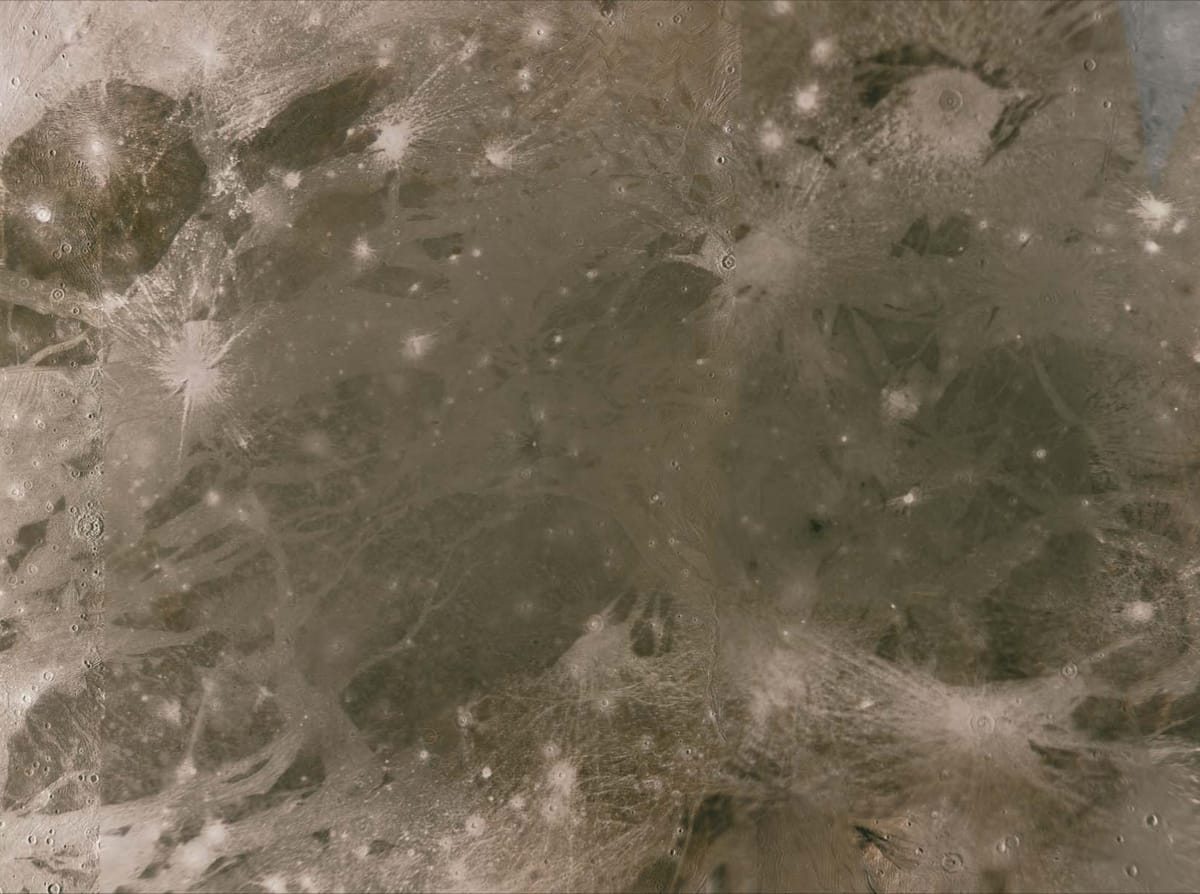
According to DeRocco, Ganymede fits this description perfectly. It’s larger than the planet Mercury and has a surface that has remained largely unchanged for more than 2 billion years. Unlike Earth, which has weather and tectonic plates that erase impact craters, Ganymede still bears signs of almost every meteor that has slammed into it, so its surface is like a geological history book.
In the study DeRocco used a computer program called iSALE to simulate what happens when a piece of macroscopic dark matter hits an icy moon.
Traditional asteroids are relatively fragile. When they collide with a planetary body like Ganymede, they explode and leave behind a bowl-shaped crater. Macroscopic dark matter on the other hand would be extremely dense, potentially as dense as an atomic nucleus (which is around 100 trillion times more dense than liquid water). And DeRocco found that instead of exploding, these objects would act like a cosmic needle, punching a deep "borehole" through Ganymede’s 12-km-thick outer ice shell.
The iSALE simulations thus revealed a unique signature that could help scientists distinguish a dark matter strike from a normal asteroid. High-speed dark matter, travelling at about 270 km/s, would easily pierce the conductive ice crust. As the hole later collapses under the moon's gravity, it will throw up a jet of liquid water and slush from the deep subsurface. This jet could ultimately bring up material from Ganymede’s subsurface ocean, such as mineral salts, and deposit them on the surface.
The result would be a relatively small crater, no wider than 10 km, surrounded by a large quantity of material with a chemical composition unlike the rest of the surface ice.
That the study has been published now isn’t incidental: the spacecraft of two major missions, NASA Europa Clipper and ESA JUICE, are currently en route to Jupiter. Both missions carry high-resolution infrared cameras and radar capable of penetrating ice. While their primary goal is to search for signs of life, DeRocco’s study suggests they could also help look for dark matter composites.
University of Cantabria, Spain, astrophysicist Bradley Kavanaugh told New Scientist that DeRocco’s idea is promising if also there’s no evidence yet that dark matter composites of the sort that Ganymede could ‘detect’ exist: “It’s more about trying to look at all the possibilities. I would say these are quite exotic objects. They’re incredibly dense and would be held together by very strong forces in some dark sector.”
Indeed, considering scientists are pretty sure dark matter exists even as empirical evidence of the substance remains out of reach, it may not be a bad idea to follow up on bold ideas — more so if the instruments it needs are already on the way.
Featured image: A view of an equatorial region of Ganymede (between 57 N and 57 S). Credit: USGS.