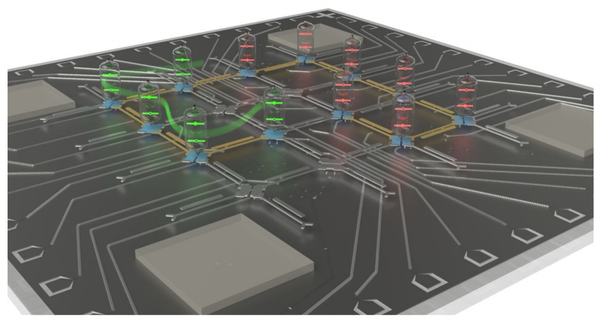
Neural network supercharges model's ability to predict phase transitions
Place a pot of water on the stove and light the fire. Once the temperature in the pot reaches 100º C or so, the water will boil to vapour. This is an example of a phase transition that occurs every day in our houses. Yet scientists have difficulty predicting whether a bunch of water molecules, like in the pot, will be liquid or gaseous in a given set of conditions.
This is different from your everyday experience with the pot on the stove and has to do with the model a computer can simulate to predict the phase of a group of interacting particles. Models that can make these predictions efficiently are prized in the study of wet surfaces, porous materials, microfluidics, and biological cells. They can also reveal ‘hidden’ phenomena we may not notice at the macroscopic level, i.e. just by looking at the water boil, and which scientists can use to make sense of other things and/or come up with new applications.
Remember your high school practicals notebook? For each experiment, you had to spell out sections called “given”, “to find”, “apparatus”, “methods”, and “results”. A model is an “apparatus” — a computer program — that uses the “given” (some input data) and certain “methods” (model parameters) to generate “results”. For example, the model below shows how a fluid with certain properties, like air, flowing around a spherical obstacle in its path, like a big rock, leads to the formation of vortices.