From the Heisenberg cut to the Copenhagen interpretation

The following post was motivated by this exchange (on X.com), which prompted me to write out my understanding of the Copenhagen interpretation of quantum mechanics and the part the Heisenberg cut plays in it. I haven’t gone into the variants of the interpretation that Maria Violaris brings up; I only focus on understanding what the interpretation does and doesn’t say to begin with, and its history.
There are many interpretations of what quantum mechanics says about reality. This is unlike classical physics, where theory and reality converge almost perfectly. If using Newton’s laws of motion you determine that a ball flying through the air will have some speed at some point, you’ll find that to be the case when you take measurements. Quantum mechanics on the other hand has some uncertainty baked into the outcomes of certain measurements; there’s no escaping it. That means the mathematical formalism describes only the probability of the outcomes of measurement rather than the event itself, creating a fundamental gap between the theory and observations that different interpretations have tried to bridge with competing philosophical explanations.
Perhaps the most popular among them is the Copenhagen interpretation: a small 2016 survey found it enjoys the most agreement among physicists; it also holds sway in the popular imagination thanks to Erwin Schrödinger’s thought experiment involving a cat that’s both dead and alive. However, Schrödinger came up with that idea to illustrate his belief that the Copenhagen interpretation of quantum mechanics paints an absurd picture of reality. The interpretation has been refined over time and is more complicated than that, and certainly not absurd.
In Schrödinger’s thought experiment, the cat is a metaphor for an observable property of a quantum system. That the cat is both dead and alive — a statement that the wavefunction of the property is in a superposition of two (or more) states. When you open the box to see if the cat is dead or alive (but not both) in the metaphor, the description of the system updates from a superposition to a single outcome.
Note that this is a simplified picture. For a more thoroughgoing account, I recommend Jim Baggott’s post ‘The Copenhagen Confusion’. Here’s a line from the operative passage: “The ‘collapse of the wavefunction’ was never part of the Copenhagen interpretation because the wavefunction isn’t interpreted realistically. The only thing that happens when an electron is detected on a screen in the context of Copenhagen is that we gain knowledge of the position of the electron.” In this post, however, I’m going to flatten these details for simplicity’s sake where necessary.
A useful entry point to the interpretation is the Heisenberg cut, which is a conceptual boundary within the interpretation. It draws the line between the quantum system, i.e. the wavefunction and probabilistic laws, and the measuring apparatus or the observer, described by classical mechanics and deterministic laws. And these two parts of the overall system share a foundational relationship: the Copenhagen interpretation uses this cut to bridge the gap between the mathematical formalism of quantum mechanics and the empirical reality of what scientists observe in a lab.
In Niels Bohr’s view, the cut is required because humans are macroscopic entities who communicate using classical language. (“It's very hard to talk quantum using a language originally designed to tell other monkeys where the ripe fruit is”: Terry Pratchett.) Bohr argued that we don’t have a choice but to describe experiments in terms of everyday physics, including positions, momenta, and times, because these concepts also define our cognitive and linguistic capabilities. This means even though the subatomic world is quantum mechanical, the instruments we use to measure it, like photographic plates and our eyes, must be treated as classical objects. The Heisenberg cut is an imaginary boundary in our description of experiments where we stop using quantum concepts and start using classical ones.
An important feature of the cut is its mobility, i.e. that a person can draw it anywhere in their description of the thought experiment: when a photon of light hits the cat, when a photon reflected by the cat reaches your eye, when you first open the box or somewhere else. According to the Copenhagen interpretation, the physical predictions of quantum mechanics don’t change based on where you make the cut, as long as it is placed somewhere along the chain of measurement. And the cut must exist if you’re to be able to ‘measure’ the system.
The Heisenberg cut is also intimately tied to the measurement problem. On the quantum side of the cut, the system will evolve according to the Schrödinger equation, which is deterministic and preserves superpositions, i.e. it allows a particle to be in two states at once. On the classical side of the cut, you observe definite outcomes: the particle is either here or there.
In effect the cut marks the point where multiple possible outcomes give way to a single recorded result. And in the Copenhagen interpretation, this transition isn’t a physical process that can be derived from the Schrödinger equation itself; instead it’s a non-dynamical event that occurs whenever a quantum system interacts with a classical measuring device. This leads to the somewhat paradoxical conclusion that quantum mechanics is a complete theory of the microscopic universe yet it banks on classical concepts (that it can’t make sense of) to make sense of its predictions.
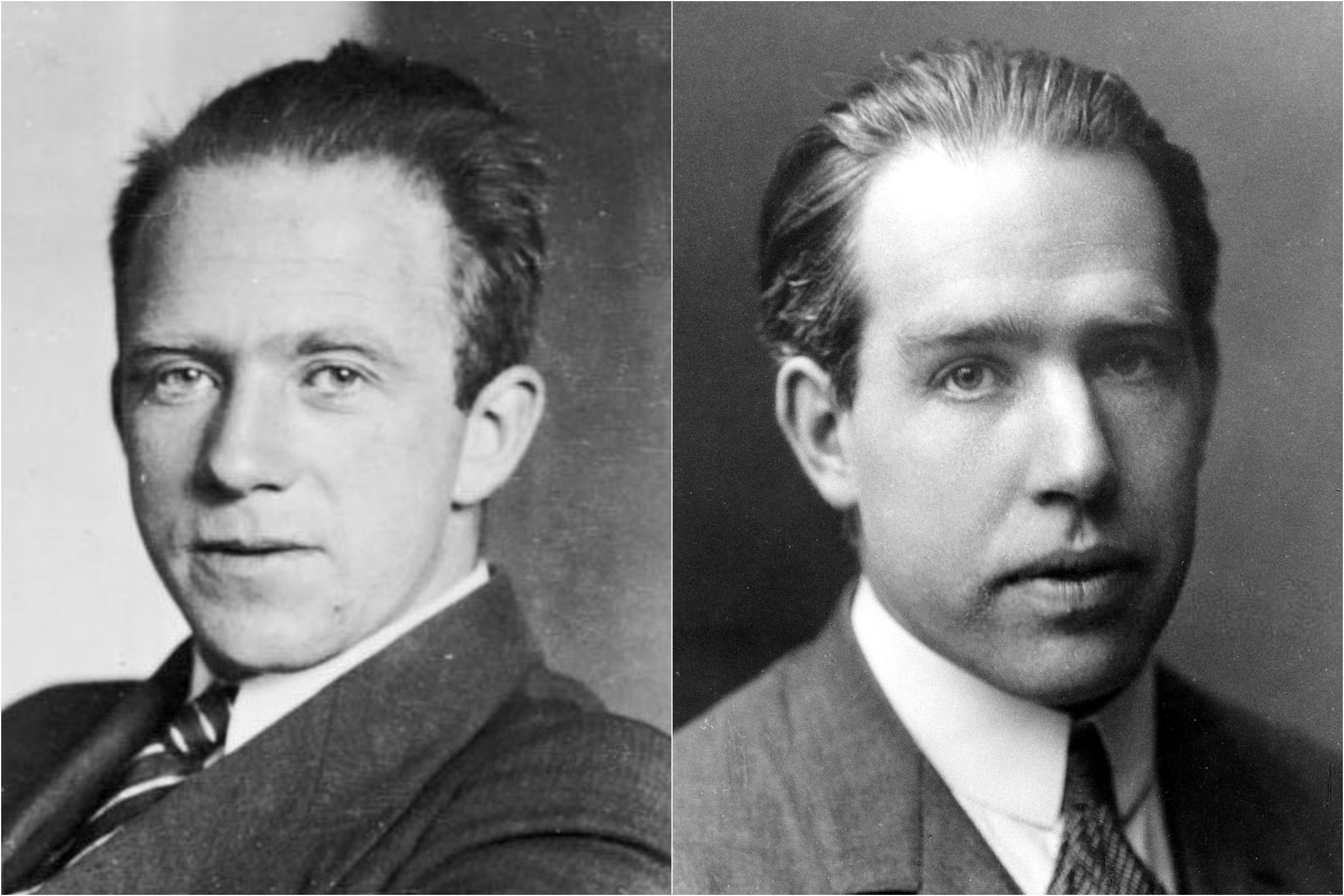
While both Bohr and Werner Heisenberg, for whom the cut is named, agreed that this cut should exist, they arrived at it for different reasons. Heisenberg treated the cut as a moveable mathematical boundary that separated the object from the subject, highlighting the subjective nature of observation. He was interested in how the observer's knowledge changed the state of the system. Bohr on the other hand viewed the cut as an epistemological necessity fixed by the experimental arrangement. In other words for Bohr the cut wasn’t about a subjective observer disrupting nature but about the objective impossibility of separating the observer from the observed in the quantum realm (a.k.a. the uncertainty implicit to quantum mechanics).
Second, let’s look at how the Copenhagen interpretation treats the maths of quantum mechanics. The theory postulates that a quantum system evolves according to the Schrödinger equation. However, our human experience is obviously discontinuous: we see definite outcomes, not superpositions. The ‘collapse’ is the instant when the system switches from its smooth quantum evolution to a single, definite state.
Without the Heisenberg cut, on the other hand, there’s no logical place for the wavefunction to collapse. If you treated the entire universe — including a subatomic particle, a microscope, a scientist, and the scientist's brain — as one giant quantum system, everything would just keep evolving according to the Schrödinger equation forever. Eventually you’d end up with a universe in a massive, complex superposition but you’d never arrive at a specific measurement or result. This is actually the premise of the many-worlds interpretation of quantum mechanics, which removes the collapse and thus removes the need for a cut.
In the Copenhagen interpretation, however, because you eventually arrive at a definite result (and which you need to do for science to be science), you’re forced to draw a line: "Everything on this side is quantum and describes probabilities and everything on that side is classical and describes facts”. The wavefunction ‘collapse’ is defined as the point at which the quantum description gives way to a single, definite experimental outcome. When the quantum system crosses the Heisenberg cut and interacts with the classical side, the wavefunction is said to have collapsed.
Thus to discuss the Heisenberg cut is essentially to discuss the mechanism of collapse and highlights the implicit dualism of the Copenhagen interpretation: the universe is divided into the observer and the observed. The wavefunction describes what’s being observed and the collapse ensures the observed entity matches the observer’s reality.
The concept of the cut originated in a few intense months leading up to Heisenberg’s publication of a paper in March 1927. At the time, Heisenberg had been working at Bohr’s institute in Copenhagen on rescuing the concept of particle trajectories, e.g. the tracks of particles recorded in a cloud chamber, which seemed to contradict the (then) new quantum mechanics.
In 1925, Heisenberg formulated matrix mechanics, the first logically consistent mathematical framework for quantum mechanics. (This invention was an important first step of the ‘new’ quantum mechanics, whose centenary physicists celebrated worldwide last year.) Among other things, matrix mechanics predicted that certain physical quantities, such as energy, take on discrete values. However, this raised questions about reconciling the theory with physicists observing apparently smooth, continuous particle tracks in cloud chambers.
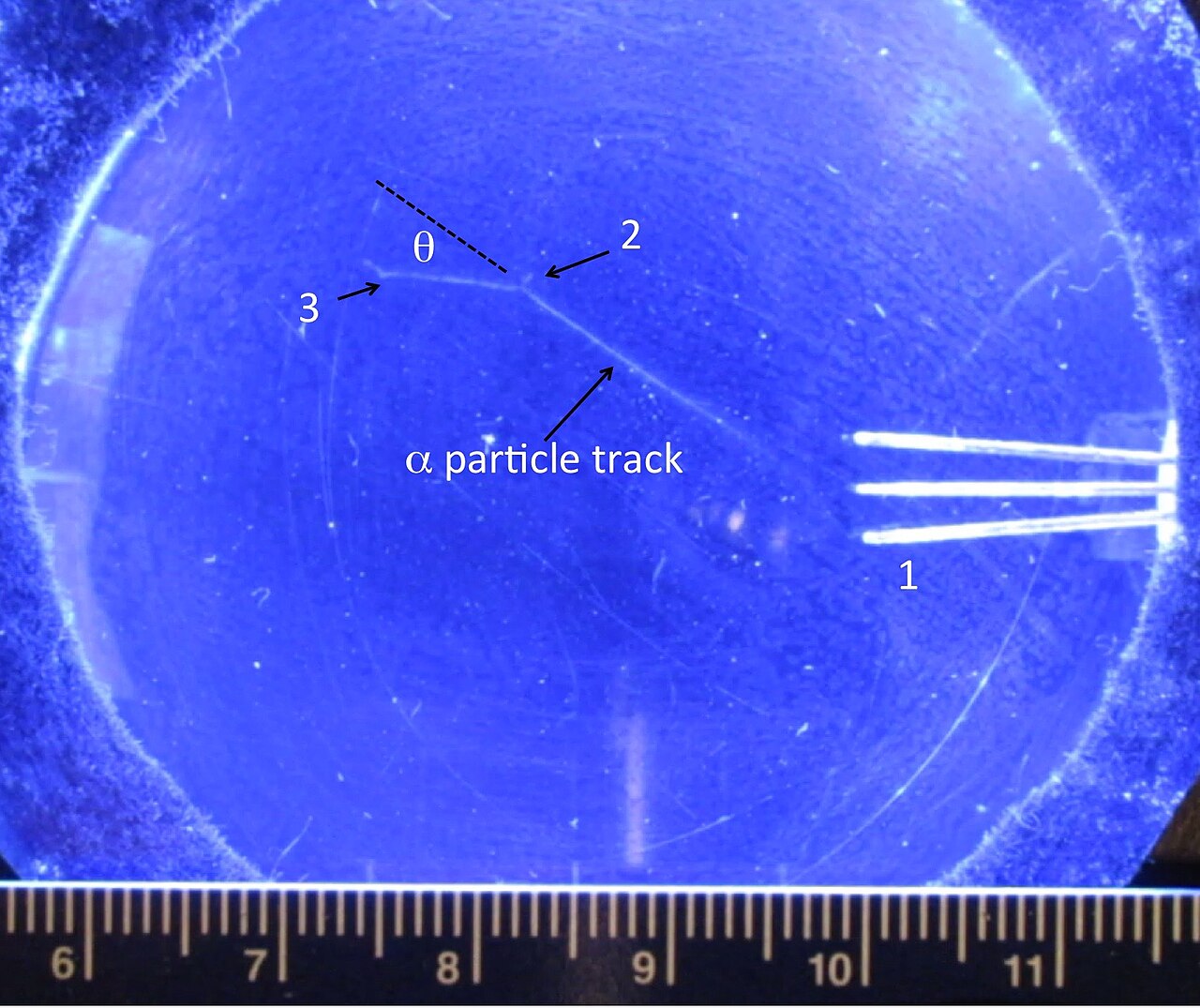
Heisenberg resolved this contradiction by redefining what a ‘path’ actually is in a cloud chamber. This is a device filled with alcohol vapour that’s supersaturated, meaning it’s cooled to the point where it’s just about ready to turn into liquid. When a charged particle moves through this gas, it knocks electrons out of the alcohol molecules, creating a trail of ions. The vapour rapidly turns into liquid droplets around these ions, forming a visible white track that traces the exact path of the subatomic particle through the chamber.
But Heisenberg argued that we never actually see a continuous path in a cloud chamber — only the sequence of individual droplets formed by ionisation. Solving the problem of the particle’s trajectory in matrix mechanics would never spit out a continuous path but it could determine the probability of an electron’s state transitioning from one discrete droplet to the next.
When we say an object transitions from point A to point B in everyday life, we mean it moved through the space in between them. But in matrix mechanics, an electron state transitioning between droplets means a discontinuous update of reality rather than movement. In the context of this post, the state of the electron is a mathematical list of properties the electron possesses at the exact moment it hits a gas molecule and creates a droplet.
So say when it hits droplet 1, the electron has energy Ehigh, momentum P1, and is roughly at position X1. At droplet 2, scientists find the same electron has energy Elow (because it lost some energy when it smashed into the first atom), momentum P2, and is roughly at position X2. In Heisenberg’s telling, the laws of physics don’t describe this journey so much as the probability of state 2 happening given state 1 just happened.
This description resolved Heisenberg’s problem because his maths only handled the energy levels and transitions; it had no variable for the particle’s location at each instant in time. In other words by looking at the cloud chamber and saying, "Aha! This track is just a pile of separate water droplets”, he could claim that the physical world also works like his maths. Which means the path we see in the cloud chamber is just our human brains drawing a line between the dots. The electron itself only becomes classically describable when it hits something.
In other words, in classical physics, the particle has a path regardless of whether we look at it, and the droplets merely reveal it. In Heisenberg's view, the particle has no defined position or path in the empty space between the droplets. Instead a path as such comes into view only because the cloud chamber is performing a rapid series of measurements: each droplet represents an observation that forces the electron to take a stand on its position while the eventual smooth line is a mental construct we create by connecting these dots.
Continuing from this idea, in a famous letter to Wolfgang Pauli and subsequently in his March 1927 paper, The Actual Content of Quantum Theoretical Kinematics and Mechanics, Heisenberg introduced a thought experiment involving a gamma-ray microscope. He argued that to observe an electron, one must hit it with a photon. This interaction would disturb the electron. He initially framed the measurement problem as a physical interaction between the electron (the system) and the photon (the probe), where the act of measurement mechanically disturbed the system.
Bohr’s critique of Heisenberg’s draft then reforged the cut as a central tenet of the Copenhagen interpretation. When Heisenberg showed Bohr his paper, Bohr tore into it arguing that Heisenberg was wrong to focus on the disturbance because he assumed the electron had a definite position and momentum before the measurement and which the measurement then messed up. Bohr insisted on the more radical view that the properties of the electron aren’t well-defined until the experimental arrangement itself is fixed. For Bohr, the cut wasn’t just where a disturbance happened but the line where the observer switched from using quantum concepts to classical concepts to describe the experiment.
The conversations on this point between the two men in February and March 1927 were intense, protracted, and emotionally exhausting. Heisenberg was 25 years old at the time and convinced he had solved the riddle of quantum mechanics with his paper whereas Bohr was relentless in his criticism, insisting Heisenberg’s fundamental premise was logically flawed.
According to historical accounts, including Heisenberg's own recollections later in life, the discussions would go on for hours, often late into the night. At one point, the combination of mental exhaustion and Bohr’s stubborn refusal to accept Heisenberg’s interpretation caused Heisenberg to break down in tears of frustration. But Heisenberg eventually capitulated, though not entirely: he didn’t rewrite the entire body of his paper but he did add a postscript to the end of the published version where he acknowledged that his explanation of the gamma-ray microscope had been too simplistic and that Bohr’s view regarding the electron’s indefiniteness was the deeper truth.
The tears were the physical manifestation of the painful process of aligning the two different viewpoints into what became the Copenhagen interpretation. In fact, and at the risk of repetition, let’s treat this interpretation as the peace treaty that reconciled Heisenberg’s idea of uncertainty with Bohr’s idea of complementarity. Heisenberg’s view was initially very mechanical and focused on the observer's limitations; he held that the fuzziness of the quantum world was a result of our clumsiness: i.e. the reality existed but our clumsy hands destroyed the data every time we tried to touch it. To him the Heisenberg cut was the place where this mechanical disturbance happened.
Bohr however worked with the concept of complementarity: that the electron has a dual nature, wave and particle, and that these two natures are mutually exclusive, meaning we can’t see both at the same time. And the uncertainty isn't because we hit the particle but because the electron literally doesn’t have a defined position and momentum at the same time. If you build an experiment to measure its position, the wave nature would vanish, and vice versa. He was saying in effect that the experiment itself defined what reality was allowed to exist at all in that moment.
The Copenhagen interpretation loosely synthesised these two views, though it leaned heavily toward Bohr’s. It stated that we must accept two contradictory truths: the mathematical formalism (Heisenberg’s matrix mechanics and the Schrödinger equation) that predicts probabilities and the classical world of our measuring devices. The interpretation is the agreement that we can’t speak about what the electron is doing when we aren't looking. We can only speak about the results of the interaction between the electron and the machine.
In effect, the Copenhagen interpretation asserts that physics isn’t about the ontological nature of the electron, i.e. what it is, but about the epistemological nature of our knowledge, or what we can say. And the Heisenberg cut is the necessary border where the indefinite, contradictory quantum world based on Bohr's idea of complementarity is forced to collapse into a single, definite fact.
If Bohr and Heisenberg provided the philosophical foundation for the Copenhagen interpretation, the Hungarian-American physicist John von Neumann gave it its formal mathematical form in his 1932 book Mathematical Foundations of Quantum Mechanics. Von Neumann was also the one to show that the mathematics of quantum mechanics allowed the cut to be placed anywhere in this chain without changing the final calculated probabilities.
Where’s Schrödinger’s cat in all of this, then? As it happens, the famous thought experiment in which the cat is both dead and alive is often misunderstood as a quirk of quantum physics; it was actually a scathing piece of satire Schrödinger designed to show that the Copenhagen interpretation was absurd. Schrödinger in fact didn’t believe a cat could be simultaneously dead and alive. His point was that if you followed Bohr and Heisenberg’s logic to its ultimate conclusion, you’d end up with such a nonsensical reality.
In fact, the thought experiment, published in 1935, targeted the concept of the Heisenberg cut. In the Copenhagen view, a quantum particle like an atom doesn’t have a defined state: it exists in a superposition of all possible states until an observer measures. Schrödinger could accept this for atoms but couldn’t digest the prospect of applying the idea to macroscopic objects.
In his mental argument, Schrödinger described a radioactive atom placed in a sealed steel box. If the atom decays in a random quantum event, a Geiger counter nearby would push a hammer, which would smash a vial of cyanide and kill a cat. If the atom doesn’t decay, the cat would live. According to the strict logic of the Copenhagen interpretation, this system remains in a superposition until an observer opens the box to check the cat’s existential status. But until the measurement itself, because the atom is both decayed and not decayed, the Geiger counter is both triggered and not triggered, and the cat is simultaneously dead and alive. Schrödinger’s question was about where the quantum ends and the classical world begins. In other words, where's the Heisenberg cut?
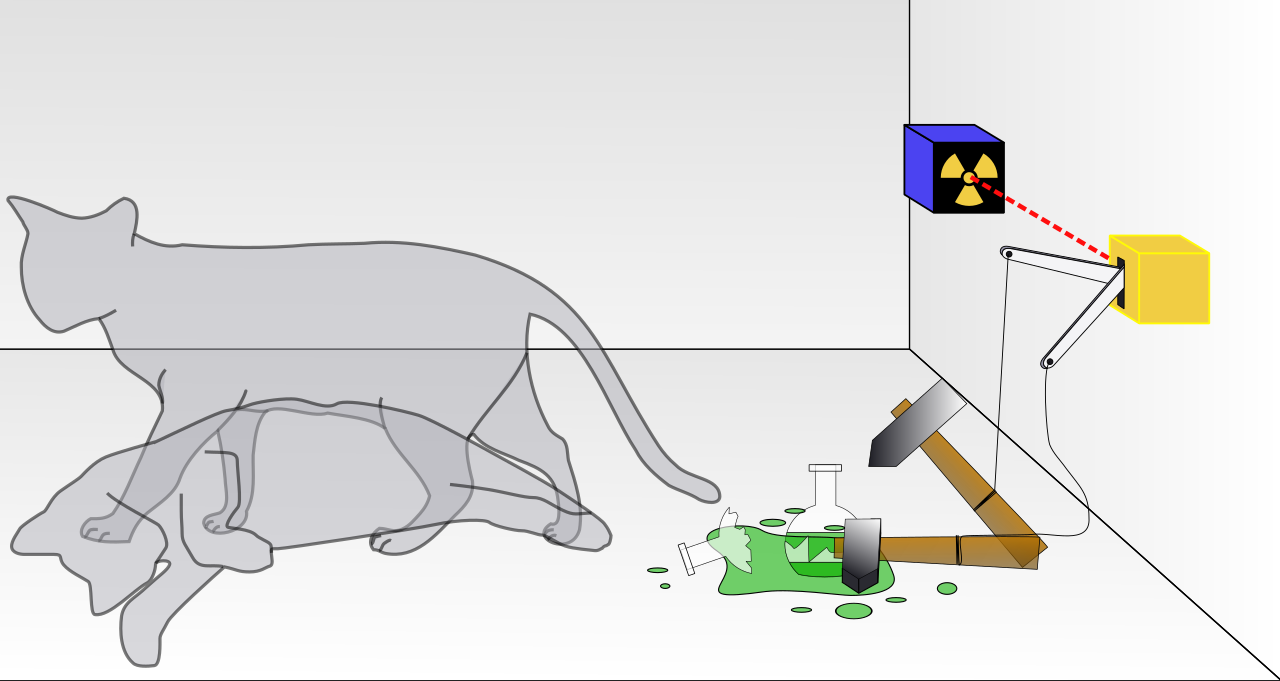
If we make the cut at the Geiger counter, the cat would be a classical object and thus either dead or alive, not both. However, Bohr, Heisenberg, and von Neumann had shown that the cut was mobile. If we moved it to the human observer opening the box, the cat itself would become part of the system’s overall wavefunction — and Schrödinger had contended that treating a living organism as a probability wave was ridiculous. He used the cat to argue that there must be something missing in the theory, some hidden variables or physical reality, that would determine the state of the cat before an observer looks at it.
For Schrödinger, the cat proved that the Copenhagen interpretation's refusal to define objective reality between measurements was a philosophical failure. It showed that while the cut could work mathematically, as von Neumann had proved, it led to macroscopic impossibilities in the physical domain.
The Copenhagen interpretation in turn didn’t surmount Schrödinger's critique by answering the riddle but by dismissing Schrödinger’s question as unscientific. Bohr argued that Schrödinger was ‘illegally’ extending quantum concepts beyond the point where a classical description would be required. In his view a Geiger counter is a macroscopic measuring device so the cut between the quantum and classical worlds would occur the moment the particle interacts with the Geiger counter. And by the time the signal reaches the hammer, let alone the cat, the quantum description would already have yielded a definite outcome at the measuring device, so the cat would never have had to be described as being in superposition.
There was also a powerful sociological narrative at the time that painted Schrödinger and Albert Einstein as an ‘old guard’ that was too stuck in classical determinism to accept the radical new truths quantum mechanics was throwing up. By 1935, the Copenhagen interpretation was the dominant orthodoxy among the younger, more productive generation of physicists like Pauli and (to a lesser extent) Paul Dirac, who viewed the cat and the Einstein-Podolsky-Rosen paradox not as genuine physical problems but as the confusion of men who couldn’t let go of the past. The proponents of the interpretation essentially declared that if the theory predicted the results of experiments correctly, then any philosophical discomfort about cats that were both dead and alive was the philosopher’s problem, not the physicist’s. And quantum mechanics perfectly predicted the results of experiments.
Historical timing also played an important part in cementing the Copenhagen interpretation’s dominance. Shortly after Schrödinger published his paper, physics shifted dramatically from the philosophical debates of the 1920s to the pragmatic urgency of the 1930s and 1940s. The rise of fascism and World War II turned the focus of the community towards nuclear energy and The Bomb. In this environment, the “shut up and calculate” approach — a phrase coined later to describe this attitude — took over and physicists shelved questions about the reality of the cat as irrelevant metaphysics.
The interpretation was also shielded by von Neumann’s mathematical authority. His 1932 book also claimed to show that ‘hidden variable’ theories, i.e. which would restore a specific reality to the cat independent of observation, were mathematically impossible. While Grete Hermann and John Bell later found this proof to be circular, for decades it served as a brick wall that convinced the physics community that there was literally no alternative to the Copenhagen interpretation.