Dispelling Maxwell's demon
Maxwell’s demon is one of the most famous thought experiments in the history of physics, a puzzle first posed in the 1860s that continues to shape scientific debates to this day. I’ve struggled to make sense of it for years. Last week I had some time and decided to hunker down and figure it out, and I think I succeeded. The following post describes the fruits of my efforts.
At first sight, the Maxwell’s demon paradox seems odd because it presents a supernatural creature tampering with molecules of gas. But if you pare down the imagery and focus on the technological backdrop of the time of James Clerk Maxwell, who proposed it, a profoundly insightful probe of the second law of thermodynamics comes into view.
The thought experiment asks a simple question: if you had a way to measure and control molecules with perfect precision and at no cost, will you able to make heat flow backwards, as if in an engine?
Picture a box of air divided into two halves by a partition. In the partition is a very small trapdoor. It has a hinge so it can swing open and shut. Now imagine a microscopic valve operator that can detect the speed of each gas molecule as it approaches the trapdoor, decide whether to open or close the door, and actuate the door accordingly.
The operator follows two simple rules: let fast molecules through from left to right and let slow molecules through from right to left. The temperature of a system is nothing but the average kinetic energy of its constituent particles. As the operator operates, over time the right side will heat up and the left side will cool down — thus producing a temperature gradient for free. Where there’s a temperature gradient, it’s possible to run a heat engine. (The internal combustion engine in fossil-fuel vehicles is a common example.)
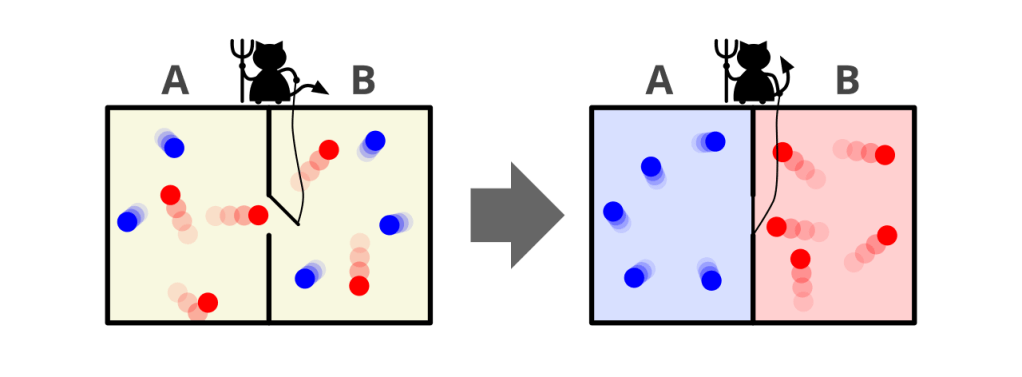
But the possibility that this operator can detect and sort the molecules, thus creating the temperature gradient without consuming some energy of its own, seems to break the second law of thermodynamics. The second law states that the entropy of a closed system increases over time — whereas the operator ensures that the temperature will decrease, violating the law. This was the Maxwell's demon thought experiment, with the demon as a whimsical stand-in for the operator.
The paradox was made compelling by the silent assumption that the act of sorting the molecules could have no cost — i.e. that the imagined operator didn't add energy to the system (the air in the box) but simply allowed molecules that are already in motion to pass one way and not the other. In this sense the operator acted like a valve or a one-way gate. Devices of this kind — including check valves, ratchets, and centrifugal governors — were already familiar in the 19th century. And scientists assumed that if they were scaled down to the molecular level, they'd be able to work without friction and thus separate hot and cold particles without drawing more energy to overcome that friction.
This detail is in fact the fulcrum of the paradox, and the thing that'd kept me all these years from actually understanding what the issue was. Maxwell et al. assumed that it was possible that an entity like this gate could exist: one that, without spending energy to do work (and thus increase entropy), could passively, effortlessly sort the molecules. Overall, the paradox stated that if such a sorting exercise really had no cost, the second law of thermodynamics would be violated.