Challenging the neutrino signal anomaly

A gentle reminder before we begin: you're allowed to be interested in particle physics. 😉
Neutrinos are among the most mysterious particles in physics. They are extremely light, electrically neutral, and interact so weakly with matter that trillions of them pass through your body each second without leaving a trace. They are produced in the Sun, nuclear reactors, the atmosphere, and by cosmic explosions. In fact neutrinos are everywhere — yet they're almost invisible.
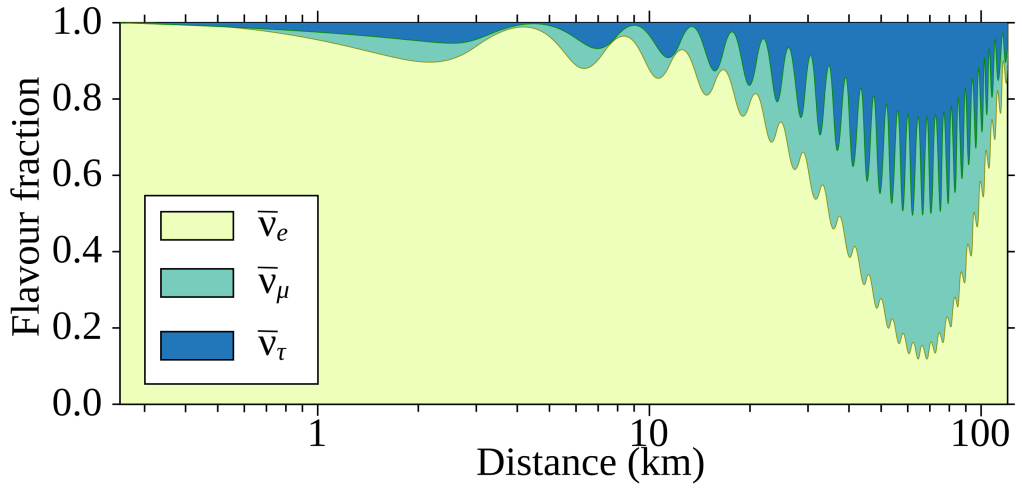
Despite their elusiveness, they have already upended physics. In the late 20th century, scientists discovered that neutrinos can oscillate, changing from one type to another as they travel, which is something that the simplest version of the Standard Model of particle physics — the prevailing theory of elementary particles — doesn't predict. Because oscillations require neutrinos to have mass, this discovery revealed new physics. Today, scientists study neutrinos for what they might tell us about the universe’s structure and for possible hints of particles or forces yet unknown.
However, detecting neutrinos is very hard. Because they rarely interact with matter, experiments must build massive detectors filled with dense material in the hopes that a small fraction of neutrinos will collide inside with atoms. One way to detect such collisions uses Cherenkov radiation, a bluish glow emitted when a charged particle moves through a medium like water or mineral oil faster than light does in that medium.
(This is allowed. The only speed limit is that of light in vacuum: 299,792,458 m/s.)
The MiniBooNE experiment at Fermilab used a large mineral-oil Cherenkov detector. When neutrinos from the Booster Neutrino Beamline struck the atomic nuclei in the mineral oil, the interaction released charged particles, which sometimes produced rings of Cherenkov radiation (like ripples) that the detector recorded. In MiniBooNE’s data, the detection events were classified by the type of light ring produced. An "electron-like" event was one that looked like it had been caused by an electron. But because photons can also produce nearly identical rings when they strike the nuclei, the detector couldn’t always tell the difference. A "muon-like" event, on the other hand, had the distinctive ring pattern of a muon, which is a subatomic particle like the electron but 200-times heavier, and which travels in a straighter, longer track. To be clear, these labels described the detector’s view; they didn’t guarantee which particle was actually present.
MiniBooNE began operating in 2002 to test an anomaly that had been reported at the LSND experiment at Los Alamos. LSND had recorded more electron-like” events than predicted, especially at low energies below about 600 MeV. This came to be called the "low-energy excess" and has become one of the most puzzling results in particle physics. It raised the possibility that neutrinos might be oscillating into a hitherto unknown neutrino type, sometimes called the sterile neutrino — or it might have been a hint of unexpected processes that produced extra photons. Since MiniBooNE couldn't reliably distinguish electrons from photons, the mystery remained unresolved.
To address this, scientists built the MicroBooNE experiment at Fermilab. It uses a very different technology: the liquid argon time-projection chamber (LArTPC). In a LArTPC, charged particles streak through an ultra-pure mass of liquid argon, leaving a trail of ionised atoms in their wake. An applied electric field causes these trails to drift towards fine wires, where they are recorded. At the same time, the argon emits light that provides the timing of the interaction. This allows the detector to reconstruct interactions in three dimensions with millimetre precision. Crucially, it lets physicists see where the particle shower begins, so they can tell whether it started at the interaction point or some distance away. This capability prepared MicroBooNE to revisit the "low-energy excess" anomaly.